
Navegue pelo conteúdo
- What Is Andropause (and Why Your Doctor Never Mentioned It)
- The 10 Most Common Low Testosterone Symptoms After 40
- Low Testosterone: How to Get Properly Diagnosed
- Andropause and Marriage — The Impact Nobody Talks About
- Integrative Treatment: Beyond Testosterone Replacement
- FAQ — Frequently Asked Questions About Low Testosterone and Andropause
- Your Hormonal Health Deserves Serious Investigation
Low Testosterone Symptoms in Men Over 40: 10 Warning Signs of Andropause
Suggested slug: drjeancarlosmd.com/en/low-testosterone-symptoms-men-over-40/
Meta description: Low testosterone symptoms in men over 40: learn the 10 warning signs of andropause, how to get properly diagnosed, and integrative treatment options.
Primary keyword: low testosterone symptoms men over 40
Secondary keywords: andropause symptoms, male hormone decline, signs of low T, testosterone deficiency after 40, low T treatment, hypogonadism symptoms
LSI keywords: testosterone replacement therapy, SHBG levels, free testosterone, insulin resistance men, erectile dysfunction, muscle loss aging, brain fog men, cortisol testosterone, male menopause, functional medicine hormones
Category: Hormones
Target audience: American men 40-65 experiencing unexplained fatigue, low libido, or mood changes
What Is Andropause (and Why Your Doctor Never Mentioned It)
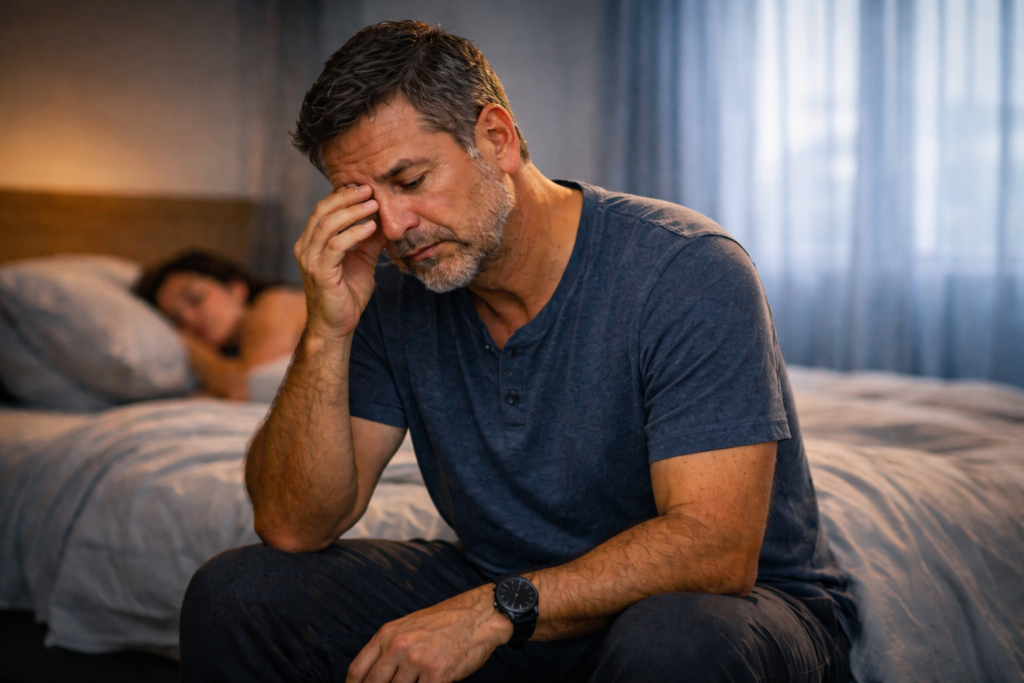
You are over 40. You sleep 8 hours and wake up exhausted. You have lost interest in things that used to motivate you. At the gym, your performance has declined. At home, your drive has faded.
You see your doctor. Blood count, glucose, cholesterol. “Everything looks normal,” he says.
But everything does not feel normal. You know it.
What probably no one investigated was your complete hormonal panel. And that is exactly where the problem lives.
Andropause — clinically referred to as late-onset hypogonadism or androgen deficiency in the aging male (ADAM) — is the gradual decline in testosterone and other androgenic hormones that begins naturally around age 30-35.
Unlike menopause in women, which has a clear marker (the last menstrual period), andropause is silent. It does not arrive all at once. It gradually erodes your energy, your libido, your mood, and your muscle mass over the course of years.
After age 30, a man loses an average of 1% to 2% of his total testosterone per year. That sounds small. But by 45 or 50, the cumulative decline can represent a 30% to 40% reduction in hormone levels.
And here is the point that few doctors address: laboratory reference ranges are extremely broad. A 45-year-old man with a testosterone level of 350 ng/dL may receive a “normal” stamp on his lab report — while being profoundly symptomatic.
Normal on a lab report does not mean optimal for you.
In functional medicine, we do not just treat numbers. We treat people. When a man walks into the office reporting chronic fatigue, loss of libido, irritability, and brain fog, we investigate deeply — even if the “basic checkup” falls within the reference range.
The NIH and the Endocrine Society recognize that age-related testosterone decline is a real clinical entity. Andropause exists. It is real. And it deserves serious medical attention.
The 10 Most Common Low Testosterone Symptoms After 40
If you are a man over 40 and identify with 3 or more of the symptoms below, it is worth having your hormones evaluated by a qualified professional.
1. Persistent Fatigue
This is not laziness. It is an exhaustion that does not improve with rest. You sleep but do not recover. You wake up feeling like you never went to bed. Testosterone is fundamental to cellular energy production, and when it drops, the entire body slows down.
2. Decreased Libido
One of the most classic signs. It is not just about sexual frequency — it is the loss of desire itself. That “spark” that existed naturally starts to dim. Many men attribute this to stress or relationship burnout when it is actually pure biochemistry.
3. Erectile Dysfunction
Testosterone is one of the pillars of erectile function. When levels drop, the quality and frequency of erections decline. Morning erections that disappear are a significant warning sign.
4. Stubborn Belly Fat
The infamous “gut that will not go away.” Declining testosterone promotes visceral fat accumulation, which in turn increases the aromatase enzyme — converting testosterone into estrogen. It creates a vicious cycle: less testosterone means more fat; more fat means less testosterone.
5. Loss of Muscle Mass
Even with consistent training, results stop coming. Sarcopenia (muscle loss) accelerates with declining androgens. Your body no longer responds to the same workout stimuli it used to.
6. Irritability and Mood Swings
The man who “became difficult to live with.” Who gets irritated easily, who has lost his patience. Testosterone plays a direct role in regulating mood, motivation, and well-being. When it drops, temperament changes. The Mayo Clinic lists mood disturbances as a recognized symptom of low testosterone.
7. Brain Fog and Memory Problems
Difficulty concentrating, frequent forgetfulness, a feeling of mental sluggishness. Testosterone is neuroprotective. Its decline directly affects cognition. Many men describe it as feeling like they are “thinking through mud.”
8. Insomnia or Poor Sleep Quality
Waking up at 3 AM, difficulty falling asleep, light and fragmented sleep. The relationship between testosterone and sleep quality is bidirectional: poor sleep reduces testosterone, and low testosterone worsens sleep. It is another vicious cycle.
9. Loss of Confidence and Drive
That impulse to achieve, to create, to lead — it starts to fade. Many men describe a feeling of “existential apathy” they cannot explain. The biochemistry explains it.
10. Night Sweats and Hot Flashes
Yes, men can experience hot flashes too. Night sweats, sudden episodes of warmth. They are less common than in women but do occur and indicate significant hormonal instability.
> [WHAT THE SCIENCE SAYS]
>
> A study published in The Journal of Clinical Endocrinology & Metabolism (2007) followed over 1,500 men and confirmed that total testosterone declines approximately 1.6% per year after age 40, while bioavailable testosterone drops about 2% to 3% per year. Another study, the European Male Ageing Study (EMAS), involving over 3,000 European men, demonstrated that sexual symptoms (loss of libido, erectile dysfunction, reduced morning erections) are the most strongly associated with testosterone decline, followed by physical and psychological symptoms. The science is clear: andropause is not “all in your head” — it is a documented, treatable endocrinological condition.
Low Testosterone: How to Get Properly Diagnosed
This is a crucial point — and where many men are underserved by the medical system.
The diagnosis of andropause cannot be made with a single total testosterone test drawn at any random time. There is a correct protocol, and it needs to be followed.
The Complete Male Hormone Panel
For a proper evaluation, the following tests are essential:
The Reference Range Problem
Labs consider a total testosterone between 250 and 1,100 ng/dL as “normal.” That range is absurdly wide.
A 45-year-old man at 280 ng/dL gets the result “within normal limits.” But his symptoms scream otherwise.
In functional medicine, we work with optimal ranges, not just reference ranges. We aim for levels that ensure full function — energy, cognition, libido, body composition, and cardiovascular health.
The Importance of Clinical Context
Numbers without clinical history are just numbers. A correct andropause diagnosis integrates:
Only with this comprehensive view is it possible to develop a truly effective treatment plan.
Andropause and Marriage — The Impact Nobody Talks About
This is perhaps the most overlooked aspect of low testosterone. And it is the one that destroys the most relationships.
When testosterone drops, a man changes. Not by choice. By biochemistry.
He becomes more irritable. Loses sexual interest. Becomes emotionally distant. Loses that energy of presence, initiative, and connection.
His wife notices. First with confusion. Then with frustration. Eventually, with resentment.
“He changed.”
“He does not want me anymore.”
“He is not the same man I married.”
These phrases echo in couples therapists' offices across America. And in many cases, the root of the problem is not emotional — it is hormonal.
I call this the biochemical divorce: when undiagnosed and untreated hormonal changes slowly erode the foundation of a relationship, generating conflicts that appear emotional but have a metabolic origin.
The Destructive Cycle
The Good News
When a couple understands that there is a biochemical component to their conflicts, everything shifts. Blame decreases. Empathy increases. And proper treatment can restore not just the man's health — but the health of the marriage.
I have seen dozens of couples reconnect after the husband began an appropriate integrative hormonal protocol. It is not magic. It is medicine.
> [CLINICAL CASE]
>
> Michael, 48, entrepreneur, Dallas, Texas (online consultation)
>
> Michael contacted our practice after nearly two years of escalating conflict in his marriage. His wife, Jennifer, said he had “become a different person” — no patience, no desire, no energy.
>
> He had already seen two urologists. The first said it was “stress.” The second prescribed sildenafil for erectile dysfunction — without investigating the cause.
>
> In the complete functional evaluation, we found: total testosterone of 310 ng/dL (technically “normal”), free testosterone at the lower limit, elevated SHBG, vitamin D at 18 ng/mL (insufficient), elevated morning cortisol, high fasting insulin, and zinc below optimal.
>
> The integrative protocol included: an anti-inflammatory nutritional plan, supplementation with vitamin D, zinc, magnesium, and ashwagandha, structured resistance training, sleep hygiene optimization, and monitoring of free testosterone every 8 weeks.
>
> At 12 weeks, Michael reported: energy returning, libido significantly improving, stable mood, and — in his words — “My wife said the Michael she married is back.” Free testosterone increased 40% with lifestyle interventions and supplementation alone.
>
> Fictional clinical case based on real-world scenarios. Individual results may vary.
Integrative Treatment: Beyond Testosterone Replacement
When it comes to andropause treatment, many think immediately about “taking testosterone.” But the integrative approach goes much further.
Testosterone replacement therapy (TRT) can be necessary and extremely beneficial in many cases — when properly indicated, monitored, and prescribed by a qualified professional. However, it is only one piece of the puzzle.
The 5 Pillars of Integrative Andropause Treatment
Pillar 1: Strategic Nutrition
An anti-inflammatory diet rich in healthy fats (olive oil, avocado, nuts, wild salmon), quality proteins, and cruciferous vegetables (kale, broccoli, cauliflower) supports hormone production and proper steroid metabolism.
Eliminate or drastically reduce: refined sugar, ultra-processed foods, excessive alcohol, and trans fats. These are true “testosterone thieves.”
Pillar 2: Targeted Exercise
Resistance training (weight lifting) is the type of exercise that most stimulates testosterone production. Compound, heavy movements (squats, deadlifts, bench press) generate the greatest hormonal response.
Important: excessive long-duration cardio can actually lower testosterone. Balance is key.
Pillar 3: Quality Sleep
Most testosterone production occurs during deep sleep. Men who sleep fewer than 6 hours per night may have testosterone levels equivalent to someone 10 to 15 years older, according to research from the University of Chicago.
Priorities: dark room, no screens 1 hour before bed, cool temperature (65-68 degrees Fahrenheit), consistent sleep schedule.
Pillar 4: Stress Management
Cortisol (the stress hormone) is a direct antagonist of testosterone. When cortisol is chronically elevated, testosterone drops. No supplement can compensate for a chronically stressful lifestyle.
Practices that help: meditation, prayer, diaphragmatic breathing, walks in nature, hobbies, and meaningful connection.
Pillar 5: Evidence-Based Supplementation and Botanicals
Several compounds have scientific evidence supporting male hormonal health:
Important: No supplementation replaces individualized medical evaluation. What works for one patient may not work for another. Dosages, combinations, and duration must be prescribed by a qualified professional.
When Testosterone Replacement Is Necessary
In cases of confirmed hypogonadism (total testosterone consistently below 300 ng/dL with symptoms), testosterone replacement therapy (TRT) may be indicated. But it requires:
TRT is not for everyone. And it is not a one-size-fits-all approach. Each man is unique, and the treatment must respect that individuality. The Endocrine Society provides clinical practice guidelines that your provider should follow.
FAQ — Frequently Asked Questions About Low Testosterone and Andropause
1. Does andropause happen to every man?
The decline in testosterone with age is universal — it happens to all men. However, not everyone develops significant symptoms. Genetics, lifestyle, nutrition, sleep quality, stress levels, and body composition all influence the intensity and speed of the decline. The NIH estimates that 20% to 30% of men over 50 have testosterone levels low enough to cause clinically relevant symptoms.
2. At what age does andropause start?
Hormonal decline begins subtly around age 30-35. Symptoms typically become noticeable between 40 and 55, depending on the individual. Unlike menopause, there is no defined “start date.” It is a gradual process, which makes diagnosis more challenging.
3. Is there a cure for andropause?
Andropause is not a disease with a “cure” but rather an age-related condition that can be very effectively managed. With proper integrative treatment — lifestyle adjustments, evidence-based supplementation, and when necessary, testosterone replacement — it is possible to restore healthy hormone levels and significantly improve symptoms, including energy, libido, and mood.
4. Does testosterone replacement therapy cause prostate cancer?
This is one of the biggest concerns and one of the biggest myths. Current scientific evidence does not support the idea that TRT causes prostate cancer in men without a history of the disease. Recent studies, including meta-analyzes published in journals like The New England Journal of Medicine, have not demonstrated a significant increase in risk. However, prostate evaluation (PSA and digital rectal exam) is mandatory before starting TRT, and regular monitoring is essential.
5. My wife thinks I need therapy, not hormones. Who is right?
Probably both. Many couples experience conflicts that have both a biochemical (hormonal) component and an emotional/relational component. The ideal approach is to investigate both. A complete hormonal panel may reveal a treatable cause for changes in behavior, mood, and libido. And couples therapy helps rebuild communication and connection. These approaches are not mutually exclusive — they are complementary.
Your Hormonal Health Deserves Serious Investigation
If you identified with the symptoms described in this article, the first step is seeking evaluation from a medical professional who looks beyond basic lab panels.
Andropause is real. It affects your energy, your health, your relationships, and your quality of life. But it can be treated.
I wrote comprehensive material about how hormonal changes can silently affect marriage and the health of a couple. It is called “Biochemical Divorce” and it may transform your understanding of what is happening in your life.
[Learn more: drjeancarlosmd.com/en/biochemical-divorce/](https://drjeancarlosmd.com/en/biochemical-divorce/)
Suggested internal links: